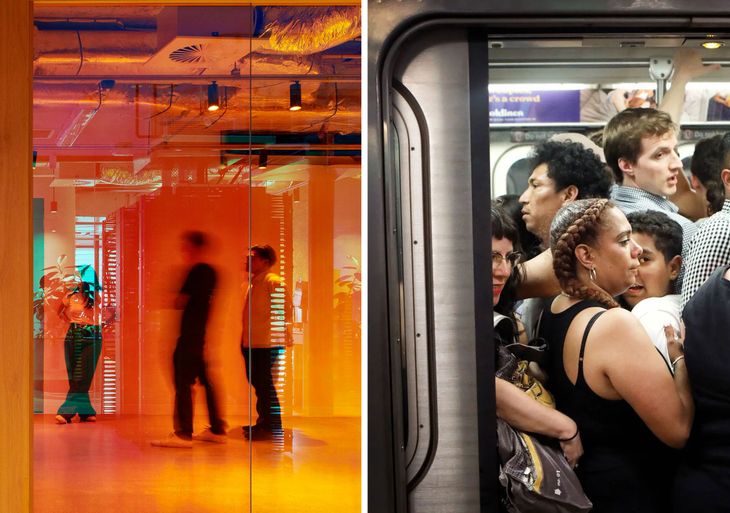
There’s a story that’s been living rent-free in my head for the past 9 months. It’s an editorial in the New York Times by Paul Ford, a software developer and writer, describing what it’s like to write code in the age of AI. He’s talking about the work, about how the process has changed. But I couldn’t stop thinking about how his place of work has changed too. Here’s the start of his article:
“On weekday evenings, heading home on the subway from Union Square in New York City, I log into an A.I. tool from my phone and write a prompt […] Underground in the subway tunnels my internet connection drops, but when my train emerges onto the Manhattan Bridge, I get a few minutes to see all the work my coding agent has done, and if I type fast enough I can issue another prompt. By the time I get home to Brooklyn, my little project tends to be done: a website, a feature in a music app, a complex search tool or some tiny game.”
If you asked me three years ago what software developers needed in their workplace, I would probably have said: a desk, a chair, a monitor (or two), a fast internet connection, quiet, space to socialise, unlimited coffee, snacks, and if they worked for a company like Google, maybe even a slide, ping-pong table, ball pit, and cafeteria tables that fit no more and no less than 12 people. In my mind, software developers were like these rare orchids that needed the perfect conditions to bloom.
If you asked me three years ago, I would have said the New York subway was the antithesis of a good workplace. It’s noisy, hot, and crowded. There are no desks, often no seats, and the internet is patchy at best. It’s a fine way to get from A to B, but hardly an award-winning office.
Despite all of this, people today are writing software on the subway. And if you look closely, you’ll find people discussing their use of AI in lots of unconventional workplaces, such as while walking the dog, while making salad, and while watching their kids at an ice skating rink. A few years ago, you might have written an email in these places, but you wouldn’t use them for deep, intricate tasks, like coding. This has changed. And I think it’s part of a significant new trend: people using AI to work from previously unviable places.
Technology changes, space follows
AI will undoubtedly reshape the office. If you go back through history, every major technology has changed the workplace – and there’s no reason to suspect AI will be any different. Here are three historic examples:
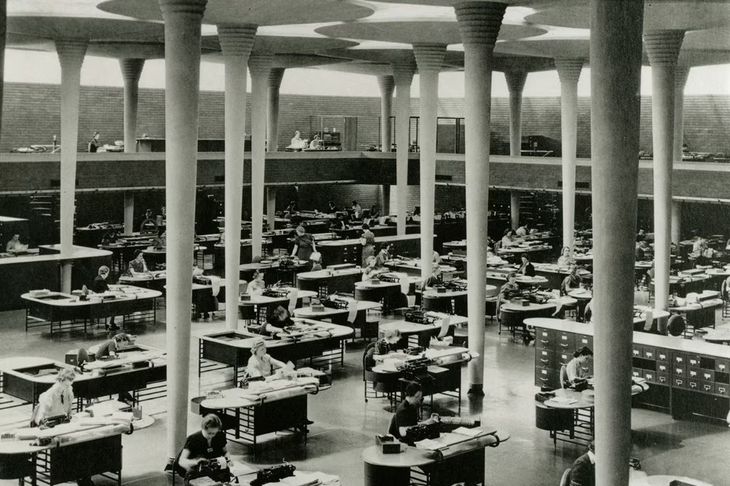 | Typewriters Typewriters mechanised manual paperwork. To accommodate this new technology, workplaces began to include typing pools, large open-plan work areas filled with rows of typewriters (such as those in the Johnson Wax Building by Frank Lloyd Wright). As information became industrialised, clerical workforces grew and offices were designed around the production, processing, and circulation of documents. |
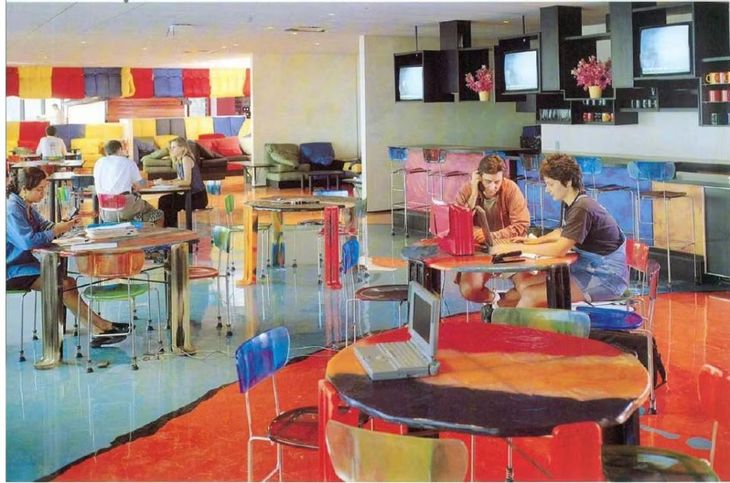 | Laptops Laptops made software portable. People could literally pick up their computer and move. With employees no longer tethered to a desk, workplaces began to offer a broader range of places to work from. Activity-based working takes off around this time (Chiat/Day were perhaps the first to take away their employees’ desks, issue everyone a laptop, and let them work anywhere). |
 | Smartphones Smartphones made people more contactable both outside and inside the office. This blurred the boundary between the personal and professional. Spaces that were normally visible only to employees could now be seen by potentially anyone. And utilitarian spaces, like bathrooms, were deliberately designed to be ‘Instragramable’ - to be viewed and admired by audiences outside the office. |
Work is losing its place
There’s no shortage of predictions about what AI will do to the office. Much of the discussion focuses on its immediate effects, such as how it might speed up tasks, introduce new uncertainty, or eliminate certain roles. People have suggested a wide range of workplace changes in response – more acoustic privacy, more decision-making space, more areas for training and innovation, and so on.
But there’s another effect that I think deserves more attention: AI is making work more portable. People are firing off prompts from their phone, like Paul Ford did on the subway. Tasks that once required a desk, computer, and monitor can now begin almost anywhere, with a prompt on a phone.
To get a better sense of AI’s impact on where we work, I surveyed a representative group of 2,500 white-collar workers in the US, UK, Australia, Singapore, and Hong Kong as part of Hassell’s 2026 Workplace Futures Survey.
One of the questions we asked them was a simple opinion question. Do you agree or disagree with the statement ‘I can use AI effectively almost anywhere, as long as I have the internet.’ More than eight in ten agreed.
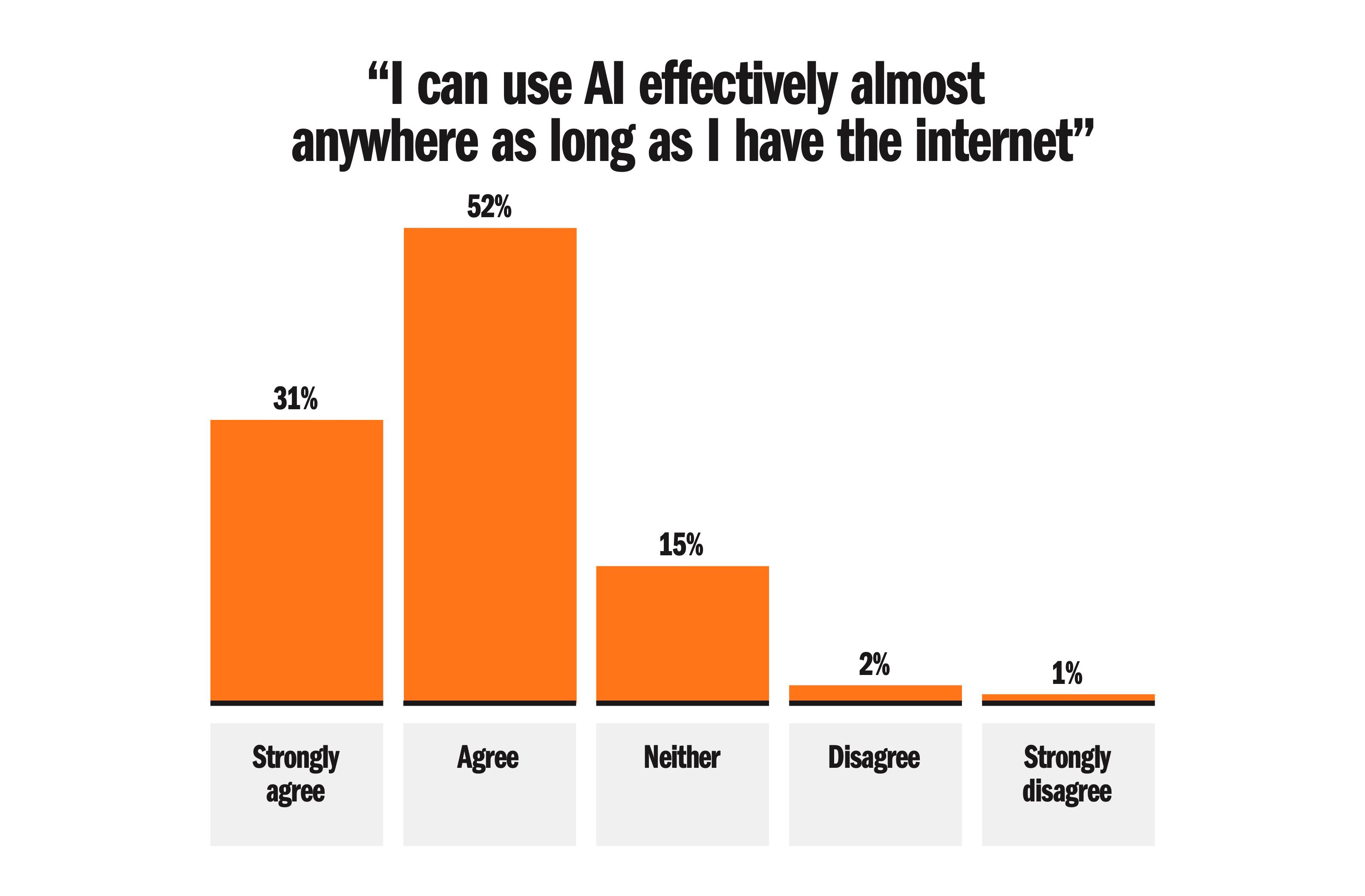
I don’t love opinion questions. What people think can be quite different to what they do. But it’s a signal that people think they can use AI effectively across a wide range of settings.
We also asked people about their actual behaviour. We asked them to think about the past year and all the places they’d used AI for their work. Virtually everyone had used AI in a conventional workplace, like their company’s office or their home. But 55% of respondents also reported using AI in less conventional settings, like from a couch, while out with friends, or in a bathroom.
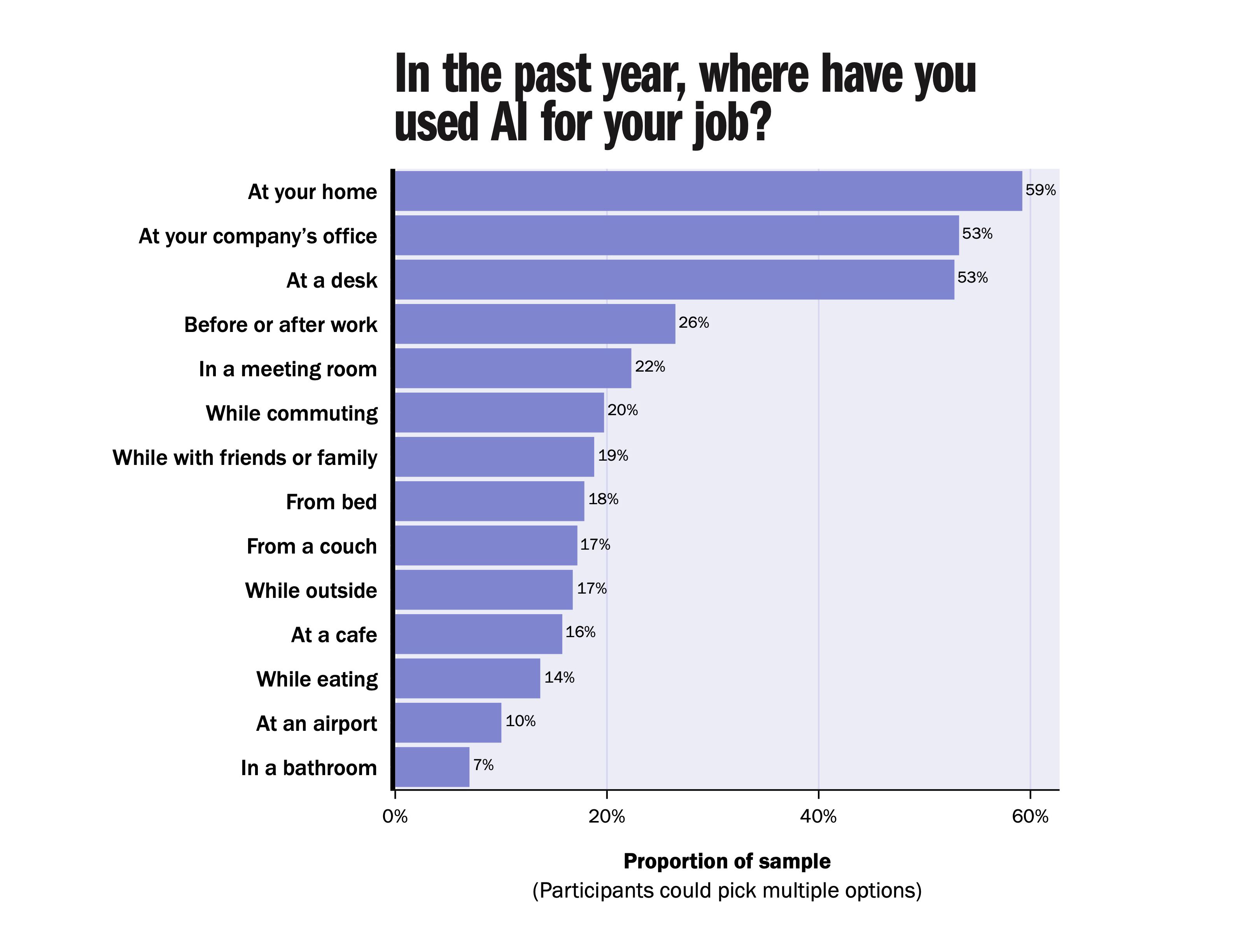
These are early signs that AI-enabled work is occurring in places that we haven't traditionally thought of as productive work settings.
In our data, young people and AI power users are much more likely to use AI in unconventional settings. These groups are at the vanguard of adoption and may offer an indication of how work habits will change. If their behaviour becomes more widespread, work could become less tethered to any one place.
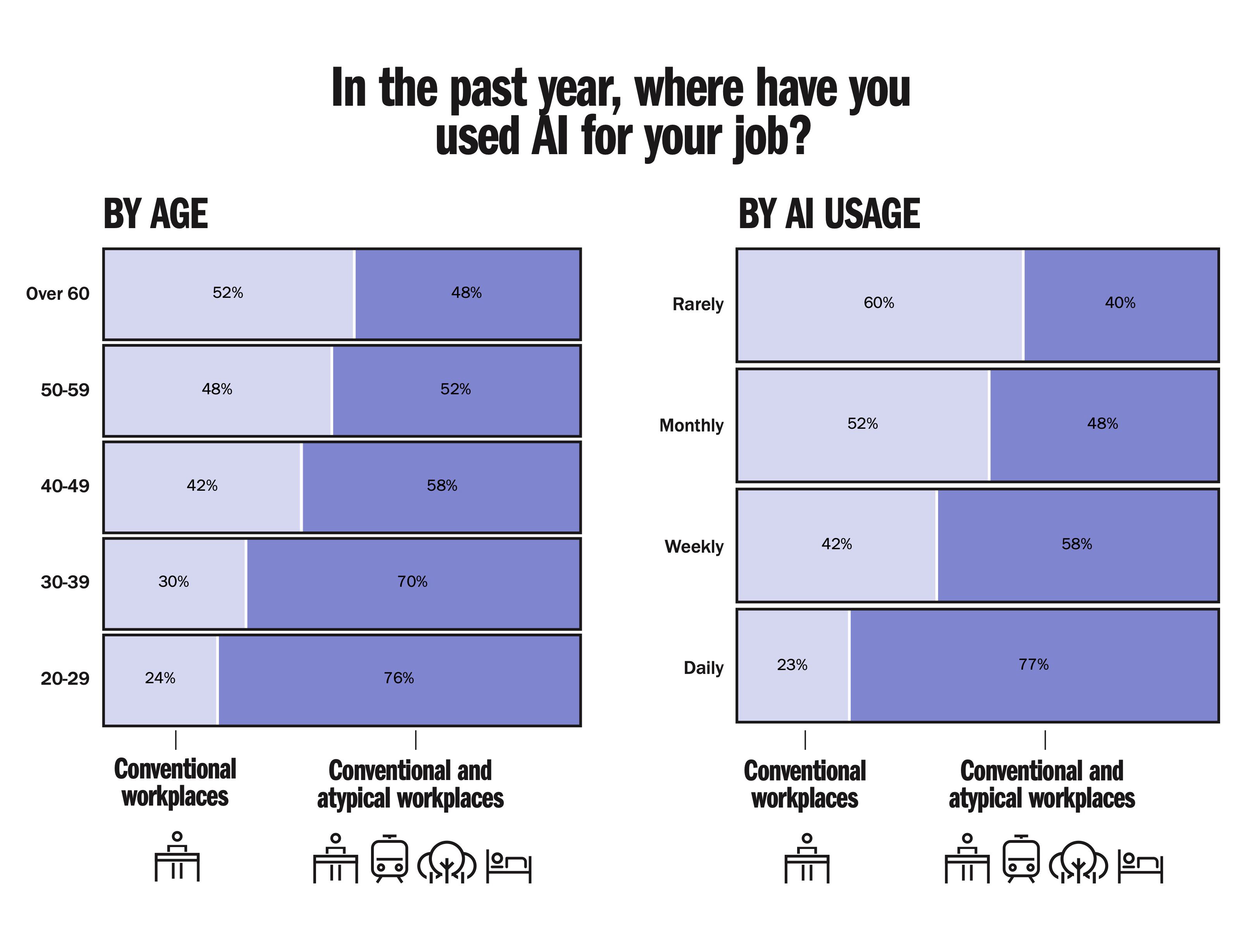
Taken together, we have stories showing how this works, people saying they can do it, and people reporting that they already are. None of this establishes that the work is equally good everywhere. It does suggest that portability deserves a place in the discussion about AI’s workplace effects.
AI-Ready is not technology-first
If AI-enabled work can happen anywhere, what is the office actually for?
In the survey, we wanted to know what the workplace could contribute. We asked people: Thinking about your company's office, what changes would most help you use AI?
The responses were fascinating. I expected people to ask for more equipment: extra monitors, better cameras and microphones for interacting with AI. Some futurists have presented a similar vision – a kind of technological maximalism, where using AI requires more and more technology in the workplace.
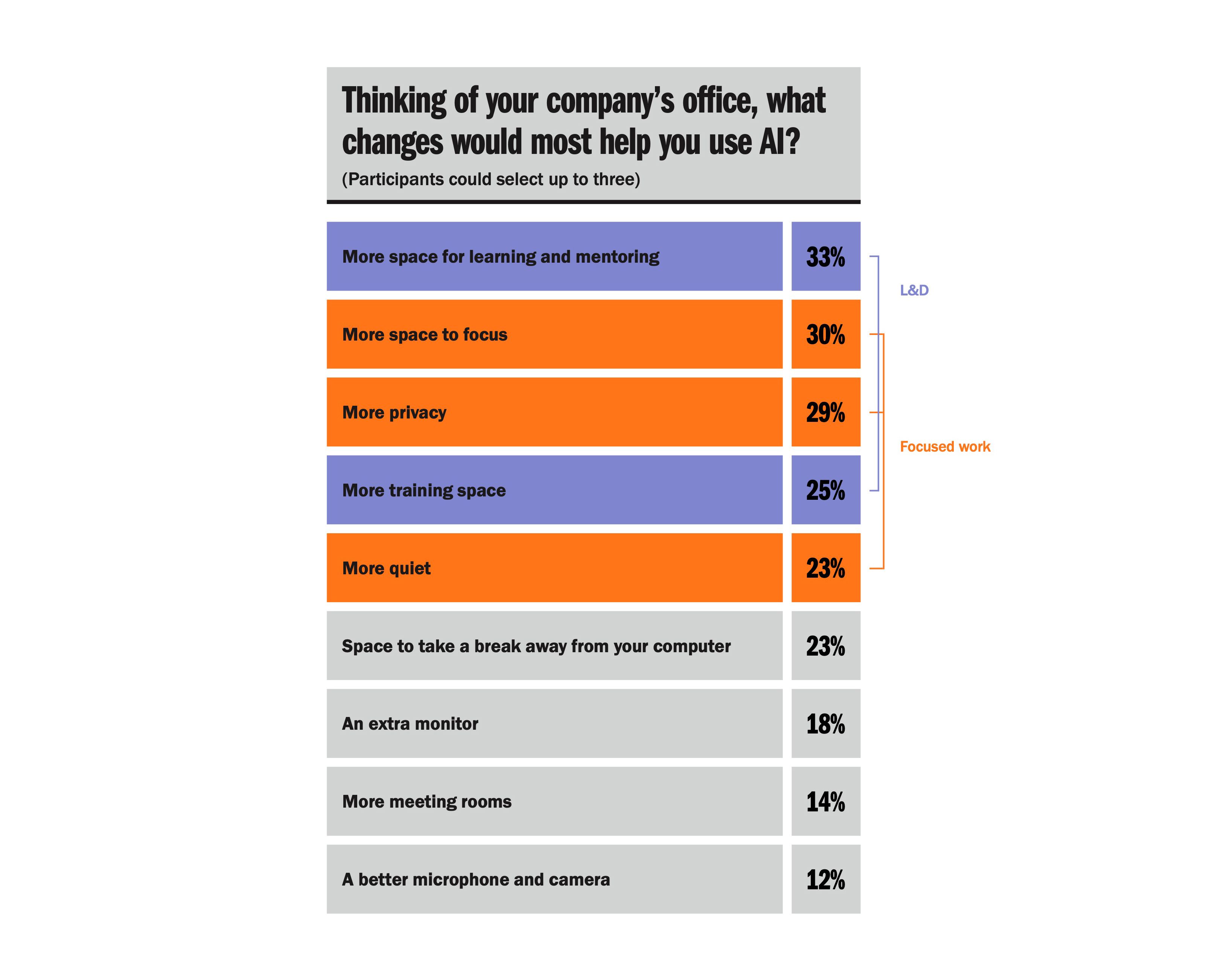
But most people asked for something much simpler: space to focus and space to learn.
The need for focus has come up in other surveys we run. I suspect that while it’s possible for people to initiate AI from almost anywhere, people still need space to think – to decide what to ask, to judge what comes back, and to work through difficult problems.
I also think that when people ask for focus, they’re not always talking about working alone. In workplace design, there’s traditionally been a divide between space for individual work and collaborative work. But when you see someone working alone today, they might be collaborating with an AI agent, or managing several of them. The boundaries between focused and collaborative work, and between individual contributor and manager, are becoming less clear.
When people ask for space to learn, I think this reflects a larger trend we’re seeing right now. We’re in an environment where the technology is changing incredibly rapidly. Many of us are finding it hard to keep up (myself included). People are asking for more support. People need opportunities to see how others work, to ask questions, to compare results. An office can make that exchange easier, provided its spaces and routines support it.
What should tenants and landlords do?
AI appears to be changing the relationship between work and place. We are seeing the early signs that some desk-bound work is now happening in places that were once considered unviable (like the coding on the subway).
For tenants, I think this means the workplace has to become more purposeful. If people can work from anywhere, the workplace has to provide things that are hard to find elsewhere. Namely: focus, mentoring, learning, privacy.
For developers and landlords, I think there could be an interesting opportunity here. If more work happens in short bursts, it might be lounges, lobbies, terraces, cafés that become the spaces that absorb some of this short-duration work. I imagine we’ll be seeing new ways to support this new form of work and capture this new demand.
The challenge for workplace design is to understand what people still need around them. You can do more work in more places – but you can’t get everything everywhere.
This article draws on Hassell’s Too Connected to Concentrate: 2026 Workplace Futures Survey – download the whitepaper.
Images – Cover left: Nicole England; Cover right: Rick Loomis; Johnson Wax Building: Domus; Chiat/Day: Donatella Brun; WeWork: @hirtsogood; all other images: Daniel Davis / Hassell.